Supercharging AI adoption across teams

Overview.
When Inizio Engage XD invested in enterprise AI, adoption lagged behind ambition. Confidence was uneven, usage inconsistent and more than half of employees weren’t embedding GenAI into their day-to-day roles.
We applied behavioural science to diagnose the real barriers and designed a virtual institution, the AI Academy – a nine-week experience designed to move people from awareness to confident application.
The challenge.
The pace of AI integration has left organisations scrambling to catch up. While 90% of companies report experimenting with AI, 60% of their people say they are self-teaching their way through the change.
At Inizio Engage XD, the stakes were immediate. The business had invested significantly in rolling out enterprise AI platforms, including ChatGPT and Copilot, across the business. But technology alone doesn’t change behavior.
More than half of employees were not yet using GenAI tools in their day-to-day roles, despite strong appetite to do so. Confidence was uneven. Usage was inconsistent. Many were self-teaching – widening capability gaps across teams. At the same time, client expectations were accelerating. AI needed to be visible, credible and embedded in workflows, not experimental or siloed.
The risk was clear: without activation, a major technology investment would remain underutilised.
This wasn’t simply a training need. It was structured capability building plus a behaviour change and mindset challenge.

The insight.
We began with behavioral science. To ensure the capability shift translated into real behavioral change, we partnered with our sister agency Forty1, employee engagement and experience specialists.
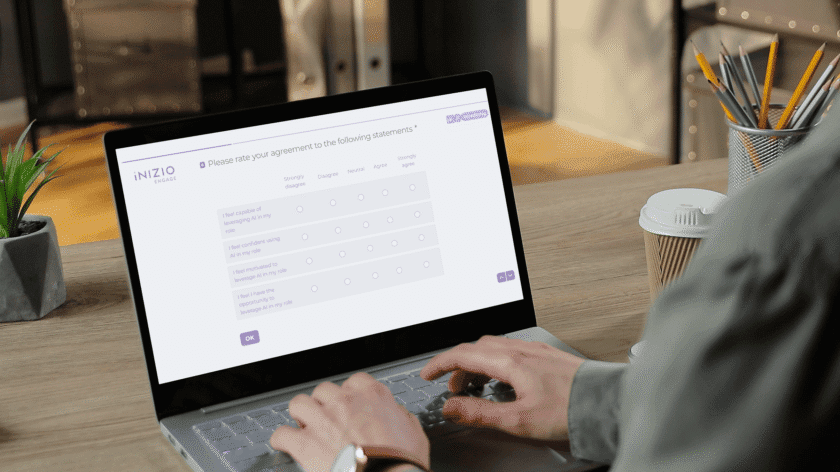
Forty1 designed and deployed an AI maturity survey to benchmark capability, motivation and opportunity at a functional and team level. This allowed us to diagnose the real barriers to adoption, not just knowledge gaps, but confidence, perceived relevance, time pressure and unclear norms.
The data revealed:
- Wide variation in AI confidence and usage across service lines
- Strong motivation to learn – if the experience felt relevant and safe
- A need for clearer leadership signalling and visible role modelling
Further insight.
Using these insights, we segmented employees into five distinct audience groups based on AI capability and behaviour – from early-stage users to confident adopters.
This segmentation became the foundation for the entire experience: differentiated learning pathways, tailored communications, and targeted engagement strategies.
Understanding the organisational environment allowed us to ensure the right interventions were applied to the right audiences – blending foundational knowledge, applied practice and leadership fluency.
This meant we could scale AI capability sustainably, building confidence, strengthening motivation and creating practical opportunities to apply AI in day-to-day work.

Our solution.
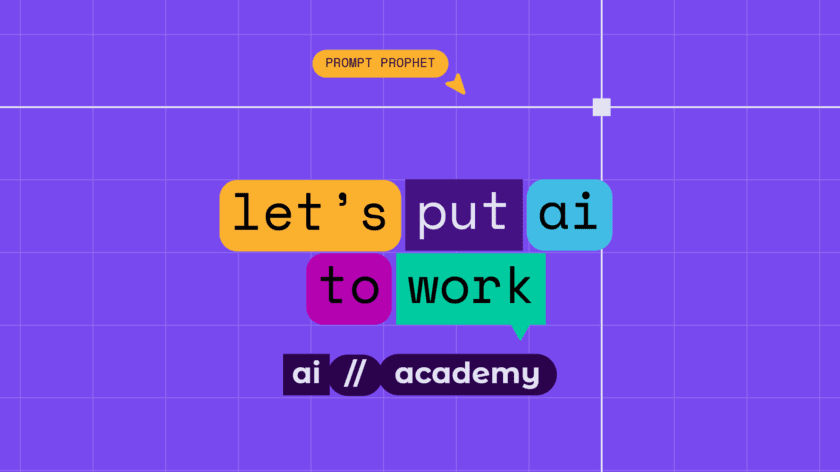
We designed a virtual institution, the AI Academy – a nine-week experience designed to move people from awareness to confident application.
The programme was deliberately flexible: teaching enough structure and skill for teams to apply AI to their own unique contexts. The programme was wrapped in a distinctive visual identity – inviting, fun and intentionally different from traditional corporate learning.
Three targeted pathways:
-

Learn
Accessible, self-directed modules building foundational knowledge in promptcraft, responsible use and workflow integration – creating a shared baseline across the organisation.
-

Explore
A cohort-based, community-of-practice bringing together confident users to experiment, build real use cases and learn by doing. Peer-to-peer interaction was central. Participants didn’t have to figure it out alone – they built capability together.
-
Speak
Leadership-focused workshops and AI-powered simulations enabling senior talent to articulate AI’s value and role-model adoption.
Innovation in practice.
The Academy didn’t just teach AI – it used AI.
- AI-generated avatars and narration enhanced accessibility
- Simulation platforms provided safe environments for leadership practice
- Enterprise AI tools were embedded into the content creation and workflow design process
- Participants built real, business-relevant AI use cases during the programme
Learning was social by design, built around communities of practice that normalised experimentation and shared language.

The engagement approach.
To drive real behaviour change, Forty1 built a behavioural science activation layer around the learning experience.
- Audience-led communications: Personalised by segment and journey stage, with differentiated tone, format and cadence to cut through noise.
- Co-created user journey: Built a nine-week experience with anticipation, social reinforcement, accountability and celebration embedded throughout.
- Rapid iteration: Monitored participation in real time, adapting communications to overcome barriers and amplify peer success.
- Leadership endorsement: Equipped senior leaders with targeted messaging and role-modelling tools to ensure visible advocacy.

The results.
1. Behaviour Shift
- Confidence using GenAI increased from 60% to 88%
- Perceived capability increased from 62% to 88%
- Employees identifying as “Active/Activated” or “Advocate/Enabler” increased from 35% to 82%
The Academy successfully moved people from awareness into action.
2. Platform Activation
Participants in the Explore pathway demonstrated significantly higher engagement with enterprise AI platforms compared to non-participants:
- 2.7x more messages sent
- 3x more agents engaged
- 3.6x more AI tools employed
Technology adoption accelerated significantly when structured, guided group learning accompanied platform access.
3. Tangible Business Outputs
- 44 real-world AI business use cases created across service lines
- 50 employees built and showcased new AI-enabled workflows
- Cross-functional cohorts strengthened collaboration across departments
AI was embedded into day-to-day operations – not treated as theoretical learning.
4. Leadership Readiness
- Leaders agreed they better understand (87%) how AI creates value
- Leaders agreed they feel equipped (73%) to lead AI-related conversations
- Leaders reported strong motivation (84%) to role-model AI adoption
AI fluency became part of leadership capability.
The impact.
The AI Academy didn’t just deliver training. It:
- Protected and activated a significant enterprise technology investment
- Shifted AI from uncertainty to shared momentum
- Built confidence, motivation and practical capability across the organisation
- Created a scalable, repeatable model for AI adoption